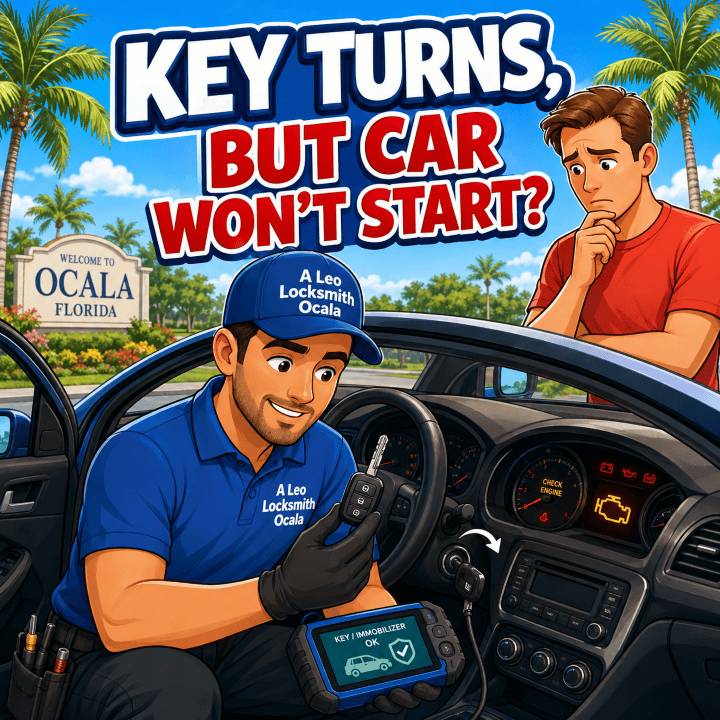
Why Your Car Key Turns but the Engine Won’t Start
🔑 Why Your Car Key Turns but the Engine Won’t Start
You insert your car key into the ignition, turn it, and expect the engine to start—but nothing happens. The key may turn normally, yet the engine does not crank, or it may crank without actually starting. This frustrating situation does not always mean the key itself is broken.
Modern vehicles rely on several mechanical and electronic systems working together. A problem with the key, ignition, battery, starter, or vehicle security system can prevent the engine from starting. Understanding the symptoms can help you decide whether you need a locksmith or an automotive repair shop.
🔐 The Transponder Chip Is Not Being Recognized
Many car keys contain a small transponder chip that communicates with the vehicle’s immobilizer system. Even when the metal blade turns the ignition correctly, the engine may not start if the car does not recognize that chip.
This can happen when:
- The transponder chip is damaged
- The key was never programmed correctly
- The key’s programming was erased or corrupted
- The vehicle’s immobilizer system has a fault
- The wrong replacement key was used
- The antenna surrounding the ignition cylinder cannot read the key
You may notice a flashing security light, a key-shaped warning symbol, or a message such as “Incorrect Key” on the dashboard. In this situation, a professional locksmith may be able to test and program the key.
🔋 The Vehicle Battery Is Weak or Dead
A weak battery is one of the most common reasons a vehicle will not start. Your key can still turn in the ignition even when the battery does not have enough power to operate the starter.
Signs of a weak battery include:
- Rapid clicking when the key is turned
- Dim dashboard lights
- Interior lights that flicker
- No sound from the engine
- Electrical accessories operating slowly
- The vehicle starts after receiving a jump
If the battery repeatedly loses its charge, the battery, alternator, or another electrical component may need to be tested.
⚙️ The Ignition Switch or Cylinder Has a Problem
The ignition cylinder is the mechanical part where you insert the key. Behind it is an electrical ignition switch that sends power to the vehicle’s starting systems.
A worn cylinder may allow the key to turn without properly activating the ignition switch. The internal connection between the cylinder and switch can also become damaged.
Possible warning signs include:
- The key feels unusually loose
- The key rotates farther than normal
- The dashboard does not light up
- The vehicle starts only after moving the key
- The key becomes difficult to remove
- The problem happens intermittently
Do not force the key. Excessive pressure could break it inside the ignition or cause additional damage.
🚗 The Steering Wheel or Shifter Is Preventing the Start
Sometimes the problem is caused by a safety feature instead of a failed part. If pressure is placed on the steering wheel while the vehicle is parked, the steering lock may bind against the ignition.
Gently moving the steering wheel left and right while turning the key can sometimes release the pressure. Never use excessive force.
Automatic vehicles must also recognize that the transmission is in Park or Neutral. Try firmly shifting into Park and attempting to start the vehicle again. If it starts in Neutral but not Park, the neutral-safety or range switch may require inspection.
🔧 The Starter or Starter Relay May Have Failed
If the dashboard lights operate normally but the engine does not crank, the starter, starter solenoid, relay, or associated wiring may be responsible. A single click when turning the key can be a clue, although a weak battery can create a similar symptom.
These components usually require testing by a qualified automotive technician. Replacing or programming another key will not repair a defective starter.
⛽ The Engine Cranks but Does Not Start
When the engine turns over but never begins running, the issue may not involve the key or ignition at all. Possible causes include:
- An empty fuel tank or failed fuel pump
- A blown fuse
- A faulty crankshaft or camshaft sensor
- A damaged ignition coil
- A fuel-delivery problem
- An engine-management issue
However, some immobilizer systems allow the engine to crank while preventing fuel or ignition operation. Checking the security light and scanning the vehicle for trouble codes can help separate a key problem from a mechanical one.
🦁 When Should You Call a Locksmith?
Contact A Leo Locksmith Ocala when you suspect the problem involves the key, transponder chip, ignition cylinder, key programming, or immobilizer system. A professional automotive locksmith can determine whether the vehicle recognizes the key and whether a properly programmed replacement may solve the problem.
Consider calling a locksmith when:
- The security light flashes while starting
- One key works but another does not
- The key is damaged or heavily worn
- The ignition cylinder sticks or feels loose
- You recently purchased an unprogrammed replacement key
- All working keys were lost
A key that turns but will not start the engine can have several causes. Avoid repeatedly forcing the ignition or buying random replacement parts. Careful testing can identify whether the trouble comes from the key, battery, ignition, security system, or starter.
For automotive key programming, replacement car keys, or ignition-related locksmith service, contact A Leo Locksmith Ocala.